1. Fasteners.
1. Fasteners.
Welcome to Carpentry
Lesson Plan: Week 1 - Welcome to Carpentry (6 Hours)
Lesson Plan Document: Week 2 - Measure Twice, Cut Once (6 Hours)
Lesson Plan Document: Week 3 - Introduction to Hand Tools.
Lesson Plan Document: Week 4 - Introduction to Power Tools.
Lesson Plan Document: Week 5 - Introduction to Wood Types.
Lesson Plan Document: Week 6 – Fasteners and Joinery.
Lesson Plan Document: Week 7 – Blueprint Reading & Design.
Lesson Plan Document: Week 8 – Framing Basics.
Lesson Plan Document: Week 9 – Finish Carpentry.
Week 10 - Final Carpentry Project: Build a Small Bench with Shelf
1. Fasteners.
What Are Fasteners?
Fasteners are hardware devices used to mechanically join or secure two or more objects together. They’re essential in carpentry, construction, and furniture building.
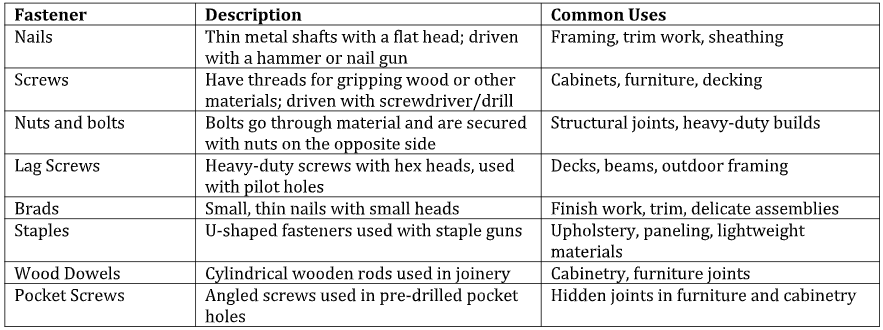
Common Types of Fasteners
Fastener Material Types.
Steel (most common) – strong and economical
Galvanized – zinc-coated for rust resistance (great for outdoor use)
Stainless Steel – rust-proof and durable, but more expensive
Brass/Copper – decorative and corrosion-resistant
Tips for Choosing the Right Fastener.
Match fastener length to the material thickness
Use coated or galvanized fasteners for outdoor use
Pre-drill pilot holes for hard woods or long screws to prevent splitting
Use washers with bolts for better load distribution
Choose appropriate head types (flat, pan, hex, etc.) for appearance and tool access