2. Engineered Woods.
Read each of the descriptions and then answer questions below.
Plywood
What it is:
Plywood is an engineered wood product made by gluing together thin layers (or plies) of wood veneer, with each layer’s grain rotated 90 degrees to the next. This cross-grain construction gives plywood excellent strength and stability.
Where & Why to Use:
Used for subflooring, wall sheathing, furniture, cabinetry, and shelving.
Preferred when strength and resistance to warping are important—especially in load-bearing applications.
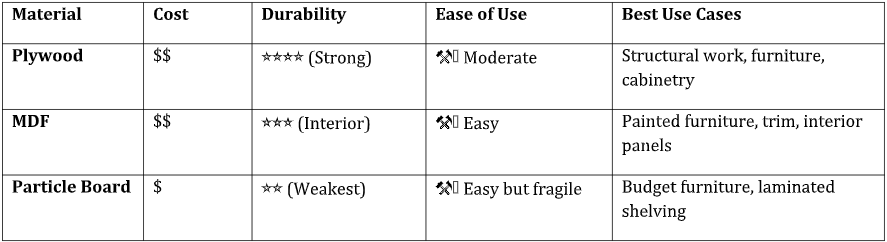
Cost: Moderate
Durability: High – strong, holds screws well, resists warping
Ease of Use: Moderate – can splinter at edges, heavier than MDF
MDF (Medium-Density Fiberboard)
What it is:
MDF is made from fine wood fibers mixed with resin and compressed into solid, dense boards. It has no grain and a very smooth surface.
Where & Why to Use:
Great for interior furniture, cabinet doors, moldings, and painted projects.
Ideal when a smooth, paintable surface is needed and structural strength is not the main concern.
Cost: Moderate
Durability: Medium – smooth but prone to water damage and edge crumbling
Ease of Use: Easy – cuts smoothly, no grain, excellent for detailed shaping
Particle Board
What it is:
Particle board is made from larger wood chips and sawdust bonded with resin and heat-pressed. It’s the least expensive and least durable of the three.
Where & Why to Use:
Common in low-cost furniture, flat-pack products, and shelving with laminate surfaces.
Best used in low-stress, indoor applications where cost is a priority.
Cost: Low
Durability: Low – weak, can sag or crumble, very sensitive to moisture
Ease of Use: Easy to cut, but edges may chip and screw holding is weak
Summary Comparison of Wood Materials