1. Introduction to Framing Concepts.
1. Introduction to Framing Concepts.
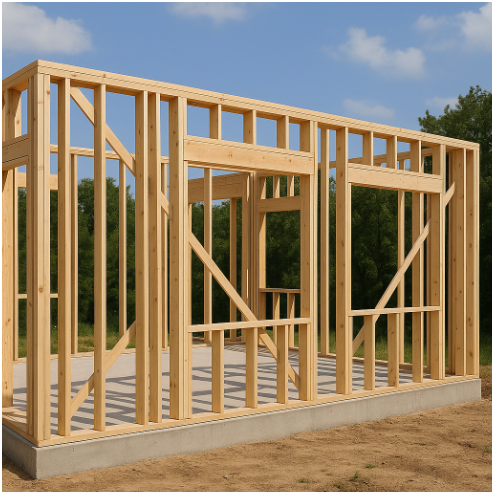
Framing is the structural backbone of any building. It gives the walls, floors, and roof their shape and support. Understanding the parts of a wall frame is essential for anyone learning construction or carpentry.
Studs
Studs are vertical pieces of lumber that form the main structure of a wall. They’re usually spaced evenly, most commonly 16 inches apart, to provide strong and stable support. Studs are what the drywall or wall sheathing attaches to.
Plates
At the top and bottom of the wall frame are long horizontal boards called plates. The top plate supports ceiling joists or roof trusses, while the bottom plate anchors the wall to the floor. Together, plates connect all the studs and form the basic frame.
Headers
When a window or door is installed, the studs that would normally go there are cut. A header is a strong, horizontal beam placed above the opening to carry the load that the missing studs would have supported.
Trimmer Studs (Jack Studs)
To support headers, trimmer studs are installed underneath them on each side of the opening.
They’re shorter than regular studs and work with king studs to frame around windows and doors.
Other Key Terms
King Stud: A full-length stud that runs from the bottom plate to the top plate and helps support the trimmer stud.
Sill Plate: The bottom piece of a window frame that supports the window itself and sits between the trimmers.
Framing must be done carefully, as it determines the strength, layout, and accuracy of everything built on top of it.